The Augsburg Saga — One Family, One City, 1,600 Years
The Augsburg Saga follows the Hartwig family across more than sixteen centuries of German history. Each generation inherits a name, a place, and a set of everyday responsibilities, forming a continuous family line rather than a collection of isolated stories.
The city of Augsburg remains the fixed point throughout the series. While political systems rise and fall and borders shift, the family stays rooted in the same streets, workshops, homes, and neighborhoods. This continuity allows history to unfold not as a sequence of headline events, but as a steady pressure on ordinary lives.
Across the books, the Hartwigs live through periods such as the medieval crusades, the rise of printing, the upheavals of the Napoleonic era, the collapse of empires, the Second World War, the divided decades of postwar Germany, and life in the present day. These moments are not presented as lessons, but as lived experience shaped by work, family ties, and daily routines.
The stories focus on practical concerns: building a house, running a shop, raising children, coping with shortages, adapting to new rules. Larger historical changes enter quietly, through letters, conversations, regulations, and absences. The tone remains calm and observational, allowing continuity and accumulated experience to shape the narrative over time.
Living History Through the Hartwigs
The Augsburg Saga presents history as it is lived by ordinary people — but ordinary life is shaped by decisions, risks, and events that leave marks. Across the centuries, members of the Hartwig family fall in love, quarrel, commit themselves to others, break away from expectations, and sometimes make choices that cannot be reversed.
Historical change does not remain in the background. It reaches the family through war, crime, hunger, political pressure, and sudden loss. These events interrupt work, separate families, force movement, and alter lives in practical ways. Love can open paths and close them again. Danger and opportunity often appear together, and the consequences of action extend beyond a single generation.
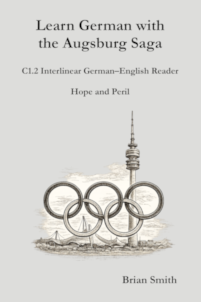
Some generations remain closely tied to Augsburg, shaped by workshops, households, and local obligations. Others leave the city under pressure or by choice: to military service, colonial and post-colonial Africa, Mediterranean travel, international events such as the Munich Olympic Games of 1972, or modern forms of work and mobility. These journeys are part of the family’s story, not detours from it.
Wars, revolutions, and political systems are not presented as spectacle, but as forces that demand response. Rules change. Work disappears or reappears in new forms. Trust becomes fragile. Romance, ambition, curiosity, fear, and loyalty unfold within these conditions, giving each period its own tension and rhythm.
Across generations, the Hartwigs inherit names, professions, and responsibilities. They also inherit unresolved conflicts, remembered decisions, and patterns of behavior shaped by earlier lives. Readers follow people rather than timelines, moving forward with the family as experience accumulates. This continuity allows long stretches of history to feel immediate, varied, and alive — driven by action, consequence, and human attachment rather than by abstract events.
Learning German Inside One Coherent World
Language development in the Augsburg Saga follows the passage of time within the story. As the centuries advance, the German used in the books becomes gradually more complex, mirroring the way learners naturally grow into a language. Early volumes rely on short sentences and concrete situations, while later books introduce denser structures, broader vocabulary, and more implicit meaning.
Because the setting and family remain consistent, readers are not required to adjust to new narrative voices or unfamiliar worlds with each book. Vocabulary expands organically across many areas of life, including craft, family relationships, trade, administration, political pressure, and modern everyday conversation.
The language of a medieval workshop, a nineteenth-century shop, a wartime household, and a contemporary family kitchen differs naturally. This allows learners to encounter German as it is used in different eras and social settings, without artificial exercises or thematic resets. Over time, German is not only read, but absorbed through familiarity with recurring people, places, and situations.
Choose How You Want to Read
The Augsburg Saga is available in several formats, designed to support different reading preferences and levels of confidence. There is no single correct way to read the series, and no required path to follow.
Some readers prefer uninterrupted reading entirely in German. Others value direct language support. Some choose to move step by step through shorter volumes, while others prefer longer, continuous editions. Each option offers the same story world, the same characters, and the same historical progression, with a different balance of challenge and guidance.
You can begin at the start, enter at your current level, or explore individual periods that interest you. The format you choose is a tool, not a commitment, and readers are free to change approaches as their confidence and goals develop.
German-Only Omnibus Editions (A1–C1)
For readers who want to read entirely in German, the Augsburg Saga is available in five German-only omnibus editions, covering levels A1 through C1. Each omnibus brings together five complete books into a single, continuous volume.
These editions are available as ebooks and paperbacks and are intended for readers who are comfortable reading without translation support. The language remains carefully controlled within each level, while the emphasis stays on flow, immersion, and narrative continuity rather than explanation.
The omnibus format is well suited for extensive reading, rereading at higher levels, and structured use in classrooms or independent study. By keeping the full arc of each level in one volume, readers can follow the family’s story with the continuity of a traditional novel.
German–English Interlinear Editions
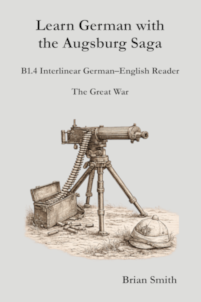
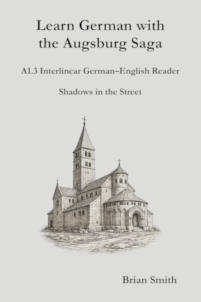
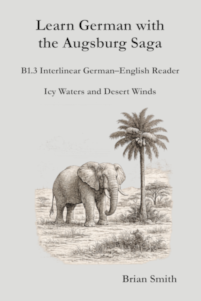
The German–English interlinear editions are designed for readers who want to keep reading without getting stuck. Each German sentence is followed directly by its English counterpart, line by line, allowing meaning to remain clear while attention stays focused on the German text.
This format supports continuous reading without frequent dictionary use. Readers can rely on the English when necessary and gradually shift their attention toward the German as confidence grows. The story, tone, and pacing remain intact, with the translation serving as support rather than distraction.
Interlinear editions are available in two forms: five interlinear omnibus editions as ebooks, and twenty-five individual books available as both ebooks and paperbacks. Readers can begin at any point from A1.1 to C1.5, depending on their level or interests.
Where to Begin
There is no required order and no expectation to read the entire series. The Augsburg Saga is designed to be explored in a way that fits your interests, language level, and reading habits.
Some readers begin at A1.1 and follow the Hartwig family from the earliest period onward. Others start at their current level or enter the story at a historical moment that feels familiar or especially relevant, such as the nineteenth century, the Second World War, or recent decades.
If you are unsure, you can read a sample chapter before deciding how to continue. From here, you can visit the overview page with full descriptions of all books or open individual sample chapters. The goal is not immediate commitment, but discovery, allowing you to find a natural entry point and move forward at your own pace.
Who This Is For — and Who It Is Not
The Augsburg Saga is for readers who want to practice German through complete stories rather than isolated exercises. It is suitable for adult learners, teen readers, and school students who want extended reading at a specific level, whether for class, exam preparation, or independent study.
Each book can be read on its own as a complete novella. Readers can choose individual volumes that match their language level or historical interests, or they can follow the Hartwig family across multiple generations and periods.
The series is designed for learners who want to experience German as it is lived. Language and meaning develop through everyday situations, recurring characters, and familiar places. As readers follow the Hartwigs through work, family life, and changing times, vocabulary and structures are encountered repeatedly in use, building confidence through recognition and continuity.
The Augsburg Saga may not be the best fit for readers who are looking for quick results or heavily instructional material. It assumes a willingness to read attentively and to learn through sustained exposure to language, whether in a single book or across the wider series.